
As a step to protect its interest as a lender, SBI will look at the financial stability and corporate governance practices in companies where it has exposure.

The problem for the NBFC sector is the funding inertia by banks and not lack of funds.

'One of the ways to do that is to ensure that NBFCs have got liquidity.' 'If we don't do that, this mood of gloom will continue.' NBFCs need to be provided with liquidity if they have to start lending.

The loss of income has severely dented the loan repayment ability of small borrowers

'The financial sector's performance in the first two quarters was a revelation.' 'It clearly showed the clean-up had been done in the past one-and-a-half years and that capital brought in was significantly stronger.'

The mergers will not involve any cash but only share swaps

Signs of financial stress were visible when the airline reported a loss of Rs 10.40 billion.

With the dizzying rise in the number of Covid-19 cases in the country, India Inc has transitioned from a wait-and-watch policy to full-on emergency mode, bringing back remote and flexi work, stringent safety protocols, and allowing only essential travel. Companies - especially in metros like Delhi, Mumbai and Kolkata - that had adopted a hybrid work model during the last few months when the caseload remained low, are either switching back entirely to work-from-home (WFH), or calling skeletal staff to office on select days. Take the case of cigarettes-to-hotels major, ITC, which had been on a hybrid work model over the last few months.
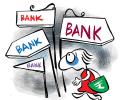
Banks now ride on what is defined as a "banking outlet". This is a fixed-point service unit, manned by either the bank's staff or its business correspondent (BC), where all kinds of services - acceptance of deposits, encashment of cheques, cash withdrawal or lending of money - are provided for a minimum of four hours per day, for at least five days a week. Banks are now turning to reposition the manner in which they acquire customers, report Abhijit Lele and Raghu Mohan.

Daniel Wu, chairman of the Asian Bankers Association (ABA), says there is merit in merging some of the less efficient public sector banks in the country.

'The economy is expected to bounce back and things are expected to recover faster than what we previously thought.'

Declining interest rates, a near-normal monsoon leading to higher rural incomes and pay hikes for central government employees are key triggers, says Dev Chatterjee.

In a bid to gain a bigger share of the customer's wallet, banks are ramping up their cross-selling initiatives.


In the aftermath of the Karvy incident, lending against third-party collateral facility raises questions over regulations concerning banks and brokers which are at loggerheads. While Sebi and NSDL have ordered the transfer of securities, which were kept as collateral, lenders followed the old business model of sanctioning loan against shares and allegedly overlooked certain parameters. Legal experts feel that this could lead to a collapse of the loan-against-shares market as it raises questions over the sanctity of the pledged securities.
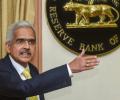
'His (Das) approach to work seems that of working as a team with ease in communication.'
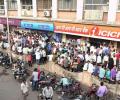
'Nobody will wait now. Everyone will come to deposit their old notes. The confidence is shaken.'

Investment banking star and Moelis India Chief Executive Officer Manisha Girotra remembers a colleague who wanted to resign because she needed to attend to her parents' health issues in a different state. Rather than quit a promising career, she was given the flexibility of working from home on Fridays, which was unusual in the pre-pandemic days. This allowed her to take care of her parents' visits to the doctor and other health-related needs without quitting her job. She would be back in the city office on Mondays.

The combined entity is set to be the third largest bank in India, behind State Bank of India and ICICI Bank.

Such cold-shoulder by banks also indicates a credit freeze that is hard to overcome, unless the government comes out with credit guarantee schemes for loans given by banks. Since that is not happening, and there is no indication of that too, banks are not willing to listen to RBI prodding.

'We tightened our risk frameworks once the Covid crisis started.' 'We are slowly lightening this as we see economic activity pick up, salaries getting restored, and people getting back into jobs.'

'67 per cent of our transactions happen digitally and about 93 per cent of transactions happen outside the branch.' 'Despite that, there is ample scope for promoting banking-related activities in branches.' 'So, for some time, we will have to, probably, live with the same structure.'

It has been a year since the Reserve Bank of India (RBI) initiated prompt corrective action (PCA), an exercise that puts weak banks under central bank scrutiny, against the 94-year-old Lakshmi Vilas Bank (LVB). But recently, this low-profile Chennai-headquartered bank found itself attracting some unwonted publicity when 60 per cent of its shareholders voted against a proposal to re-appoint seven directors, including one of the promoters, K R Pradeep (who holds around 2 per cent), and the company's managing director & chief executive officer S Sundar.

The venue for Saturday's meeting was shifted at the last minute from the headquarters of the India Banks' Association in Cuffe Parade to avoid media glare.

'I hope the trend is sustainable and that economic activity accelerates going forward.'

From auto, refrigerator, and mobile handset makers to real estate firms, companies are tying up with banks to dole out attractive finance schemes and discounts to make buying more affordable.

Indian bankers are fearful that going out of their way to save Jet could lead to subsequent harassment from investigative agencies.

For development finance institution to succeed now, the government must stand like a rock behind it and be patient.

State Bank of India (SBI) chairman Rajnish Kumar, in conversation with Abhijit Lele, also says that the overhang of corporate debt stress will begin to recede in the next two-three quarters.

'When there is unlocking, there is demand revival.' 'This is going to be the main growth engine in this kind of an economic scenario.'
P S Jayakumar, managing director and chief executive officer, Bank of Baroda, speaks to Abhijit Lele & Hamsini Karthik about loan recoveries, sounding more confident than a year before.
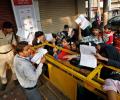
There is not much bank employees can do, but some words of encouragement from the management would have helped. Stretched working hours and the tense atmosphere is taking a toll on their health.

If a name does not unify the three, there could be continued clash of identities, which could splinter the brand even before it takes shape, say Abhijit Lele and Nikhat Hetavkar.
Is the worst over for Indian banks? The past two years saw them ride on treasury trades as deposits soared and credit growth dipped sharply. Gross and net non-performing assets (NPAs) moved south, and the provision coverage ratio (PCR), capital buffers, and profitability indicators are back at pre-pandemic levels. So, what's the plot ahead?

Is the SBI chairman leaving the bank in a stronger and better position than what it was? Abhijit Lele finds out.

'Mostly, the relief, if needed, would be for housing loans where a person has lost a job and is unable to pay his EMI or there has been a temporary salary cut.'

Interview with former Reserve Bank of India governor by Duvvuri Subbarao.

Over 25,600 cases of banking fraud reported up to December 21, 2017, says Minister RS Prasad.

Modi has been relentless in building his brand regardless of banks having a problem of fraudulent and unauthorised transactions with his companies.
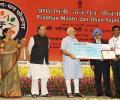
Government's financial inclusion mission is well intentioned, but it may be putting a severe strain on the banking sector.
